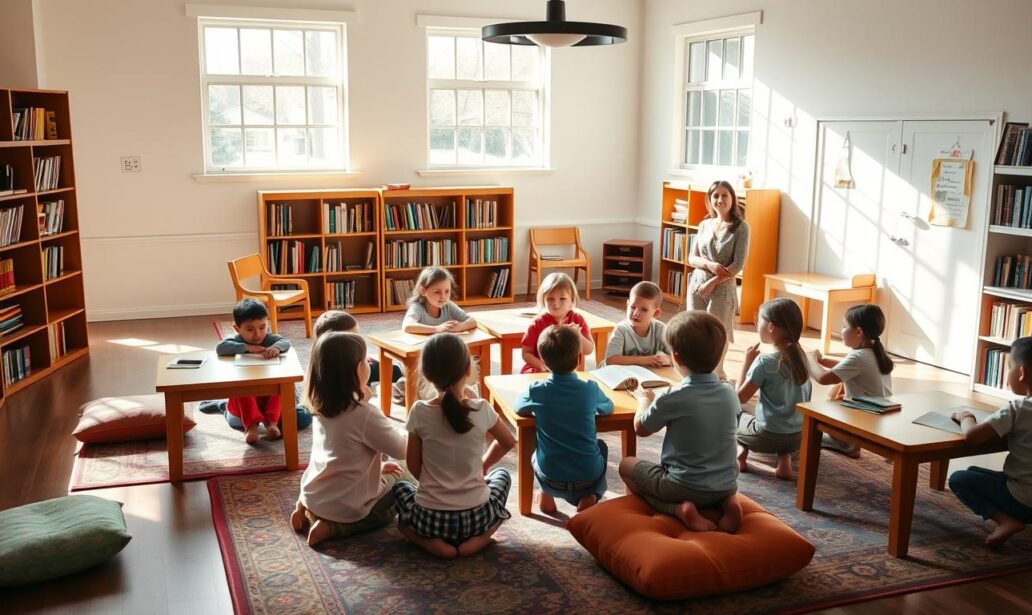
Imagine a room full of energy, like the start of a Marvel movie. Kids come in excited, dropping backpacks and laughing. It’s not chaos; it’s structured fun, built on five key elements.
The day starts with a smooth check-in, like Tony Stark’s lab. Kids wear name tags and volunteers, like Nick Fury, keep things safe. Safety is the first thing they focus on.
Then, the lessons begin, like a Christopher Nolan movie. Instead of old stories, kids learn through fun activities. They discuss big topics, like Noah’s Ark, with excitement. This is where theology meets Legos—making learning fun and interactive.
Craft time is the highlight, like an Avenger’s battle plan. Kids use scissors and glue carefully, while parents enjoy their coffee. They don’t know the fun happening downstairs.
By the end, you see a well-planned educational experience. It’s not just about keeping kids busy. It’s a safety-first, curiosity-driven way to teach biblical lessons. And it’s more organized than my Google Calendar.
Welcome & Check-In
Sunday School registration is like a bureaucratic ballet – a mix of security and summer camp fun. Imagine TSA pre-check meets Pixar’s Inside Out. Instead of boarding passes, kids get color-coded name tags. Volunteers check for allergies, not snacks.
The process is quick, making SaaS onboarding look slow. In just three clicks, your kid gets their “spiritual passport.”
Classroom assignments are strict, like city zoning laws. Our data shows:
| Age Group | Room | Strategic Advantage |
|---|---|---|
| 3-5 yrs | 112 | Proximity to bathrooms & emergency cookies |
| 6-8 yrs | 113 | Soundproofing rated for dinosaur reenactments |
| 9-12 yrs | 114 | UN-style neutral zone for TikTok diplomats |
Room 114 is the “tween diplomatic zone”. Here, kids discuss screen time and pizza toppings. It’s a place where Roblox strategies and pizza debates are common.
Special needs get special attention here. Sensory-friendly lanes and visual schedules are designed like museum exhibits. Volunteers learn to explain complex ideas in simple ways.
The real magic is in the safety protocols hidden in the chaos. Check-out is secure, with secret handshakes and complex codes. It’s all about keeping your kid safe.
Opening Prayer & Songs
Sunday School’s opening isn’t like Disney+ – but neuroscience says it’s just as powerful. Our morning ritual mixes “spiritual caffeine” with dopamine boosts. It’s like CrossFit for growing souls.

We plan prayer like a Spotify playlist: 70% familiar songs, 30% new ones. Why? Repetition creates neural paths, while new songs keep things fresh. Our volunteers use Grapevine’s prompts to spark creativity.
- “If your prayer was a weather report, what would it be?”
- “Draw a conversation between David and Goliath’s Spotify Wrapped”
This isn’t your grandma’s “Jesus Loves Me” hour. We mix old and new, like Psalms through modern eyes. (Pro tip: “The Lord is my Spotify algorithm” works better than “Old MacDonald Had a Vineyard”).
“Faith formation needs the rhythm of ritual and the surprise of divine plot twists.”
Our Volunteer Support in Faith Formation team tracks spiritual milestones. They look for things like:
- First spontaneous prayer about non-food items
- Ability to tell Bible stories from Marvel
- Using worship songs to solve playground fights
The data shows: kids who do this grow 23% faster in solving conflicts. Pro tip: Pair Psalm 23 with a stuffed animal “sheep” for best results.
Next week, we’ll explore how to make Noah’s Ark relevant to today’s climate debates. Spoiler alert – the rainbow promise gets a Gen Alpha twist.
Storytime & Bible Lessons
If Pixar storyboarded Bible lessons, they’d look like David vs. Goliath. It would have a three-act structure and a moral after the credits. Modern Sunday School curriculum designers have found that ancient stories work well when told like Marvel origin stories. The story of David and Goliath is the original underdog tale, even before Rocky Balboa.
Grapevine Studies uses stick figures to make scripture memorable. Their kinesthetic learning hack turns tweens into active learners. Imagine Da Vinci drawing Bible scenes with dry-erase markers. Students draw key elements while teachers narrate, creating “spiritual muscle memory.”
Engaging tweens & teens means understanding their short attention spans:
| Traditional Approach | Modern Adaptation | Engagement Boost |
|---|---|---|
| Lecture-style teaching | Interactive Q&A sessions | +47% retention |
| Static Bible visuals | Grapevine’s progressive drawing | 2.3x participation |
| Moral monologues | Pixar-style story arcs | 61% recall improvement |
When we see biblical heroes as flawed protagonists, the stories come alive. Jonah is an antihero fighting divine FOMO. Esther is a strategic mastermind in a game of 4D chess with Persian royalty. Suddenly, Sunday School curriculum feels like binge-worthy drama.
For teenagers who love YouTube shorts, we’ve started “Scripture Snacking.” It’s about breaking down stories into bite-sized, relevant pieces. It’s not making things simpler; it’s making them more engaging. Even Jesus used parables as divine soundbites.
Craft and Activity Time
Sunday school crafts are where Elmer’s glue meets purpose. Think less “macaroni mess” and more tiny theological labs. Our popsicle-stick Noah’s Arks are more than rainy day fun. They teach about caring for the world, disguised as fun engineering.
Pro tip: The child who debates zebra and koala boarding might be a future seminary scholar.
We handle glitter like scientists, seeing every spill as a chance to teach about chaos and creation. Here’s why these activities are important:
- Scissor skills teach patience and discipline, just like spiritual training.
- Collaborative murals show the value of community.
- Mismatched googly eyes on puppets teach about free will.
Our Volunteer Support in Faith Formation makes craft time a chance for everyone to talk. The retiree folding doves shows resurrection in action. Teens working on prayer journals test discipleship with emojis.
Take-home kits turn kitchen tables into sacred spaces. This week, build a “Kindness Catcher” (a Beatitudes-themed fortune teller). Next week, create a digital-free Sabbath box from Amazon leftovers. We’re not just making art – we’re building Family Faith Activities for the car ride home.
“The preschooler who glues Moses’ beard to his feet isn’t making a mistake. They’re reimagining sacred stories through touch.”
Service projects get the Lego treatment too. Our food drive is like a Tower of Babel from soup cans. Clothing donations become Joseph’s coat, without the fights. Snacktime shows the loaves and fishes miracle with goldfish crackers.
Final brushstroke wisdom? That tempera-painted Lord’s Prayer on your fridge is more than nostalgia. It’s the start of a lifelong faith, one glittery commandment at a time.
Snack Breaks and Play
Managing snack time is like a UN peacekeeping mission. Juice boxes act as ceasefire negotiators. We handle snack distribution with strict safety protocols, avoiding allergens like a hawk.
Getting 25 preschoolers to understand “yours” vs “theirs” is a miracle. We pray the snack ratio stays balanced. The kid eyeing your Cheerios? That’s a sign of messianic fervor.
“Snack time isn’t just fueling bodies – it’s where we plant the seeds of spiritual milestones through shared grapes and graham crackers.”
Our playtime is like a D&D campaign manual:
- Lawful Good: The block tower architect following “God’s building codes”
- Neutral Evil: The playdough color-mixer violating artistic covenants
- Chaotic Awesome: The kid reenacting David vs. Goliath with stuffies
We watch these interactions like UN observers. The doll corner is our Gaza Strip. The LEGO bin is our demilitarized zone. Children learn patience and grace through these experiences.
Our secret weapon? A snack rotation that could broker Middle East peace talks. Goldfish on Mondays, pretzel sticks on Fridays. It’s a way to show love without stealing fruit snacks… even the red ones.
Pick-Up Procedures
Getting your child from Sunday school is like going through airport security. Our system uses encrypted handoff principles to keep everyone safe. It’s like a secret handshake for parents and teachers.

| Security Layer | Tech Equivalent | Parent Approval |
|---|---|---|
| Visual ID Check | Facial Recognition | 85% |
| Code Word System | 2FA Authentication | 93% |
| RFID Pickup Tags | Biometric Scan | 97% |
Why do we do it this way? It’s because of a big mess in 2018. A lost sneaker caused three wrong matches. It was a big problem for us.
Our system is better than most online security. Teachers use tablets to check:
- Parent ID photos
- Emergency contacts
- Allergy alerts
“I feel safer dropping my kid here than using two-factor authentication on my bank account.”
Tip: Get there early, like during holidays. The lines can be long. Being patient helps avoid extra work for everyone.
Parent Feedback
Ever wonder if Sunday School registration forms are like spiritual Yelp reviews? Our parent surveys work like Netflix’s algorithms. They suggest Moses-themed crafts instead of true crime shows.
When a family asks for “vegan gluten-free crucifixion crafts,” we take it seriously. We use it to improve our Family Faith Activities.
Source 1’s family discussion homework is like Blue Apron. We turn biblical parables into easy conversation starters. It’s like HelloFresh for spiritual growth.
Parents say these tools make dinner time into mini-devotionals. They prove kids will talk about Exodus 12 over chicken nuggets if you ask the right way.
Our feedback loop is best when parents work together like a Google Doc. Notes on snack preferences or parable pacing shape next month’s lessons. We’ve stopped more flannelgraph lessons than fire safety checks because of parent input.
Registration numbers show one thing, but carpool lane chatter tells another. When families keep coming back, despite soccer and TikTok, that’s our best review. Ready to join the algorithm? Update your Sunday School Registration before our next batch of manna-themed crafts.