
Asbury United Methodist Church in Salisbury, Maryland, gave its summer youth service a clear rhythm in 2026. Rather than announcing one large volunteer day, the church scheduled three monthly delivery sessions for Salisbury Urban Ministries: June 16, July 21, and August 18. Each session ran from 8 a.m. to 10 a.m., and participants had to be at least 16 years old.
The church described the project as youth-led but invited adults to serve beside the younger participants. Suzy Creel, Asbury’s director of youth and family ministries, was named as the contact. That structure turns a summer activity into something more dependable: young people take visible responsibility, adults provide support, and an established community organization receives help on a repeat schedule.
Asbury has not published delivery totals, volunteer counts, or a list of items transported during the July 21 session. Those results should not be assumed. The confirmed schedule still gives churches a useful model for connecting faith, youth leadership, adult mentorship, and practical local service.
Why Monthly Service Creates A Stronger Ministry Pattern
A single service day can introduce young people to community outreach. A recurring project gives them time to learn what reliable service requires.
The three-date Asbury schedule created a simple progression. Participants could serve in June, return in July with a better sense of the process, and apply what they learned during the final session on August 18. The two-hour window made the commitment clear enough for families and adult volunteers to plan around it.
That repetition matters in youth ministry. Young people can move from waiting for instructions to helping prepare materials, confirm assignments, communicate with team members, and notice problems before the next session. Adults can observe which tasks fit each participant and where more guidance is needed.
A repeat schedule can strengthen the community partnership, too. Salisbury Urban Ministries does not have to receive a new introduction from an unfamiliar group every month. Church leaders can coordinate with the same organization, use an agreed process, and adjust their support based on real operational needs.
Consistency should not be confused with expansion. A church does not need to add more projects every month. It may serve its community more effectively by returning to one qualified partner, performing a limited set of tasks well, and keeping its commitments.
The Asbury project reflects that approach. Its public description focused on monthly deliveries rather than broad promises about solving hunger, poverty, or other community problems. It placed the youth team inside an existing ministry relationship and gave the service a defined beginning and end.
Salisbury Urban Ministries Gives The Work A Real Community Context
Salisbury Urban Ministries operates several established programs from its Barclay Street location in Salisbury. Its Lazarus Food Pantry is open on Tuesdays and Thursdays from 10 a.m. to noon. Its Kid’s Cafe provides an after-school and summer setting for children connected with Beaver Run Elementary and East Salisbury schools.
The organization lists prescription assistance for residents of Somerset, Worcester, and Wicomico counties. It is connected with God’s Kitchen, a Saturday meal program hosted by Grace Methodist Church. Salisbury Urban Ministries says 48 organizations take turns hosting the meal and that the program serves an average of 200 meals each week, or about 10,400 meals per year.
Those programs show why a delivery assignment can matter even when the public never sees a dramatic event. Community ministries depend on routine work: moving supplies, maintaining schedules, preparing program space, checking inventory, communicating with volunteers, and getting materials to the correct location.
Youth participants gain a more accurate view of service when they help with that routine work. Community support is often built through repeated, ordinary tasks rather than one public campaign.
The partner organization should still decide what help is useful. A youth group should not arrive with donated items, create its own intake process, or change a delivery schedule without approval. Churches can ask the partner what needs to be transported, how supplies should be packed, which records are required, and which parts of the operation must remain with trained staff.
That distinction protects the relationship. Youth volunteers contribute energy and time, but they should not replace employees, handle private client information without authorization, or make decisions that belong to the community organization.
Youth Leadership Works Best With Real Responsibility

A youth-led project should give young people meaningful responsibility without placing them in situations beyond their age, training, or authority.
Leadership can begin before the delivery morning. Youth participants might help confirm the meeting time, review a loading plan, divide tasks, prepare a checklist, or remind the group about clothing and transportation requirements. During the session, they might organize supplies, track completed tasks, welcome volunteers, or report a problem to the adult leader.
Afterward, the group can discuss what happened. Useful questions include:
- Did the team arrive prepared and on time?
- Which task helped Salisbury Urban Ministries most?
- What delayed the work?
- What should change before August 18?
- Did every participant have a meaningful role?
- What did the experience reveal about community needs?
Reflection separates a repeatable learning experience from a task completed and forgotten. Federal guidance on youth civic engagement describes volunteering as one form of civic action through which young people can develop skills, values, community awareness, and a sense that they can contribute to public life. Its service-learning guidance places special value on organized service that addresses a real community need and gives participants time to reflect on the experience. (youth civic engagement guidance)
A church project does not become a formal educational service-learning program simply by adding a discussion. The same principle remains useful: young people learn more when adults explain why the work matters, connect it to the church’s teaching, and invite honest reflection.
Adult Participation Should Support Youth Leadership
Asbury’s announcement said the project was not limited to youth and invited adults to join them. That detail creates an intergenerational ministry rather than a youth group working in isolation.
Adults can provide transportation, supervision, institutional knowledge, and help with physically demanding tasks. They can model reliable communication and show how long-term relationships with community organizations are maintained. Their presence can help youth participants take on more responsibility safely.
Adult participation needs clear boundaries. If every decision remains with adults, the project may be described as youth-led without giving young people a real voice. Church leaders can reserve selected responsibilities for youth and explain which decisions require adult approval.
A simple leadership structure might look like this:
| Project Area | Possible Youth Responsibility | Adult Support |
|---|---|---|
| Preparation | Review checklist and confirm assignments | Verify details with the partner |
| Arrival | Help organize the group and supplies | Manage transportation and site contact |
| Delivery Work | Complete assigned tasks and track progress | Supervise safety and solve higher-risk problems |
| Communication | Share reminders with participants | Approve public information |
| Reflection | Lead part of the post-project discussion | Guide questions and document lessons |
The age requirement of 16 or older gives Asbury a clear participation boundary for this particular project. Other congregations should set age limits according to the assignment, transportation plan, partner requirements, church policy, and local safeguards. An age rule used by one church should not be copied without reviewing the actual work.
Safe Youth Ministry Requires More Than Good Intentions
Asbury states that its Safe Sanctuary program has been in effect since December 31, 2009. The church identifies it as a framework for protecting children, youth, vulnerable adults, and the people who serve with them. Its youth ministry page says the guidelines draw from United Methodist Safe Sanctuaries resources.
The church’s 2026 calendar adds a practical detail: Asbury held Safe Sanctuary training on June 28 and stated that everyone aged 18 or older who works with children, youth, or vulnerable adults must complete the training. That requirement appeared between the first and second summer delivery dates, showing that service planning and safeguarding were treated as connected responsibilities. (Asbury Youth Ministry)
United Methodist Discipleship Ministries advises local congregations to create, apply, and monitor abuse-prevention and risk-reduction policies for ministries involving children, youth, and vulnerable adults. The agency describes safety as part of discipleship rather than a separate administrative concern.
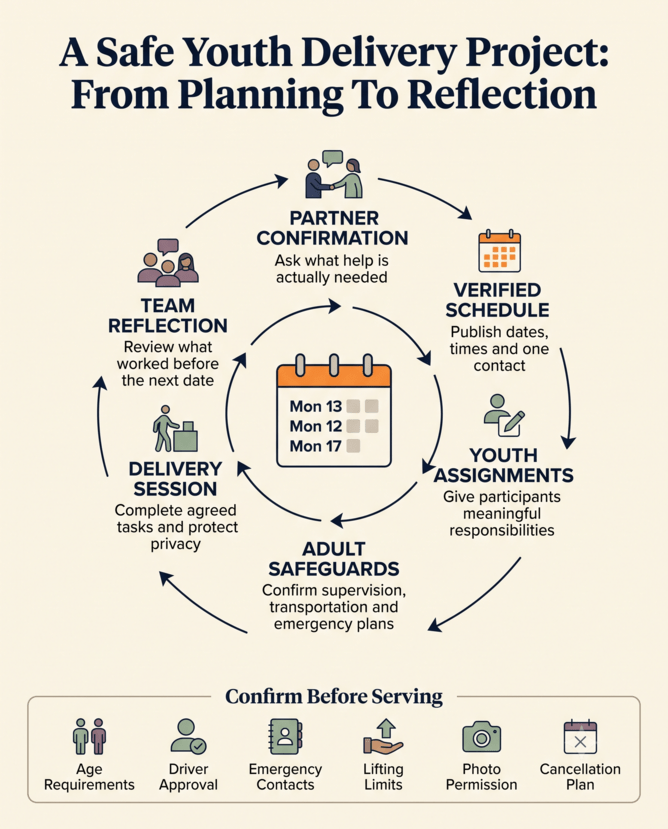
For a delivery project, church leaders may need to review:
- Adult-to-youth supervision expectations
- Transportation permission and driver requirements
- Emergency contacts and medical information
- Attendance records
- Physical lifting limits
- Appropriate communication between adults and youth
- Photo and social-media permissions
- Procedures for reporting an injury or safeguarding concern
Training should match the project. A two-hour delivery does not require the same preparation as an overnight mission trip, yet a short assignment still needs named supervisors, an emergency plan, and clear expectations.
Predictability Helps Community Partners Plan

Salisbury Urban Ministries operates programs on fixed weekly schedules. The Lazarus Food Pantry and prescription-assistance services run on Tuesdays and Thursdays. Kid’s Cafe operates four days each week, and God’s Kitchen provides a Saturday meal.
Organizations working on that timetable cannot base operations on occasional volunteer enthusiasm. They need people and supplies to arrive when expected.
Asbury’s once-a-month delivery plan offers a manageable commitment. The church publicly listed all three dates, the two-hour service period, the minimum participant age, and the ministry contact. Families could see the full schedule rather than receiving a last-minute invitation before each session.
Churches creating similar programs should confirm each date with the partner, assign a backup leader, and decide what happens when too few volunteers register. Weather, vehicle problems, illnesses, or supply delays may change the plan. The community organization needs to know quickly if a promised delivery cannot take place.
Public information should remain current. After July 21 passed, Asbury’s event calendar continued to identify August 18 as the final session. A current calendar reduces confusion and gives new adult volunteers time to ask questions before joining.
No church should advertise a delivery on behalf of a partner until both organizations have confirmed the date, responsibility, and contact process.
Faith Becomes Visible Through Dependable Action
Asbury’s youth ministry says its mission is to help young people connect scripture with daily life, care for their community, and put faith into action. The summer delivery project gives that language a concrete form. Youth are asked to show up early, work with adults, support a named local organization, and return on a schedule.
That model can help churches move beyond service events built mainly for photographs or attendance totals. A ministry becomes more useful when the partner can count on it and the young people understand who benefits from their work.
Recognition still has a place. Churches can thank participants, share what the group learned, and invite youth leaders to speak about the experience. Public updates should protect the privacy of people receiving services and avoid presenting community members as props in a ministry story.
The same operational discipline appeared in Bethel’s examination of practical food-and-diaper outreach, where clear schedules, partner roles, volunteer assignments, and realistic limits mattered more than broad claims about impact.
Youth-led church service should be judged by similar questions. Did the project meet a need identified by the partner? Did youth receive real responsibility? Were adults prepared to supervise without taking over? Did the church keep its promise? Did the team learn enough to serve better the next time?
Asbury’s 2026 summer deliveries do not provide a complete formula for every congregation. They show a credible pattern: choose an established community partner, create a limited recurring assignment, place youth in visible roles, invite adults to support them, and build safety into the ministry plan. That is how faith expressed through service can become consistent community work.
What Churches Should Confirm Before Starting A Youth Delivery Project
Church leaders considering a similar program should begin with the receiving organization. They should ask what needs to be delivered, who prepares it, which vehicles are suitable, how many volunteers can work safely, and what information must remain private.
The church should name one coordinator, publish verified dates, prepare a cancellation process, and train adults under its safeguarding policy. Youth responsibilities should be stated before the event so participants know that they are being invited to lead rather than simply attend.
Leaders should resist claims they cannot document. Asbury’s public materials confirm the schedule, age requirement, community partner, and youth-led structure. They do not report how many deliveries were completed on July 21, how many volunteers participated, or how many Salisbury residents benefited. Responsible church reporting leaves those figures unstated until an official source provides them.
A dependable youth service network does not need to be large. It needs a real community purpose, trustworthy adult support, a schedule the church can keep, and space for young people to learn from each session.