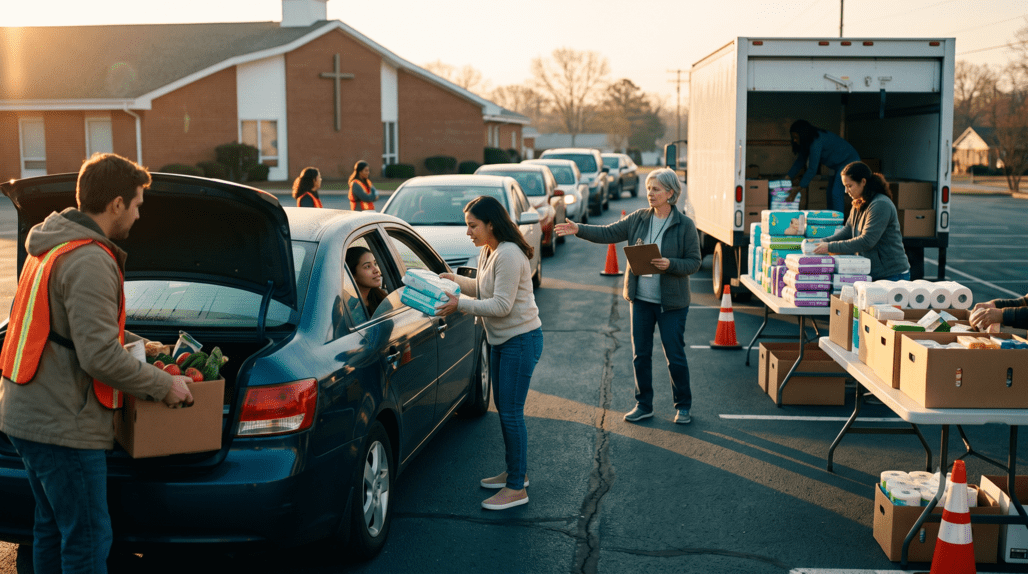
Rock Church El Cajon’s July 21, 2026, community distribution shows why church outreach can become more useful when it addresses connected household needs rather than treating hunger as an isolated problem. The Provisions Ministry scheduled a free drive-through event from 10 a.m. to noon at 808 Jackman Street in El Cajon, California. Its official listing said the ministry would distribute food and diapers supplied through partnerships with the San Diego Food Bank, Feeding San Diego, and local donors.
The event announcement did not publish attendance figures or the quantities distributed, so those outcomes should not be assumed. The confirmed details still offer a useful model: a defined schedule, established nonprofit partners, several volunteer roles, a clear service format, and household supplies that cannot always be purchased through nutrition-assistance programs. Churches considering a food ministry can learn as much from that operating structure as from the items placed in each vehicle.
Practical Outreach Starts With The Full Household Need
Food insecurity rarely exists by itself. A family struggling to buy groceries may face the same pressure when purchasing diapers, wipes, transportation, household cleaning products, school supplies, or personal-care items. A church pantry that distributes canned food but never asks about related necessities may serve one urgent need while leaving another barrier untouched.
Diapers are a strong example. The U.S. Department of Agriculture identifies diapers and wipes as nonfood items that cannot be purchased with Supplemental Nutrition Assistance Program benefits. Families receiving SNAP may use those benefits for eligible groceries, but they must find another way to pay for diapers. That policy gap helps explain why food banks and community organizations often distribute both products through the same network.
The Jacobs & Cushman San Diego Food Bank says one child may require about 50 diaper changes each week, or roughly 2,600 changes a year. Its current program information estimates that a month’s supply can cost between $70 and $80. The organization distributes diapers through food programs and a network of more than 450 nonprofit partners across San Diego County.
Those figures are specific to the Food Bank’s program materials and should not be treated as a universal household budget. They clarify why diapers belong in a serious discussion about family stability. Childcare providers commonly require parents to supply diapers, which means a shortage can affect a parent’s ability to work, attend school, or keep a childcare arrangement.
Churches do not need to stock every household product. They should identify which needs are recurring, which supplies can be obtained reliably, and which local organization already has the purchasing, storage, and distribution system required to respond.
Partnerships Let Churches Serve Without Rebuilding A Food Bank
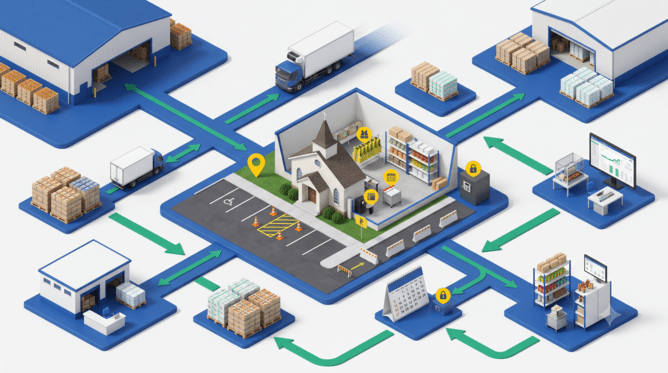
Rock Church El Cajon does not describe its distribution as a stand-alone supply operation. The Provisions Ministry receives food through the San Diego Food Bank, Feeding San Diego, and local donors. That structure allows the congregation to contribute volunteers, space, local relationships, and a regular distribution point while regional organizations manage larger sourcing and logistics systems.
Feeding San Diego reported that it provided more than 31 million meals between July 1, 2024, and June 30, 2025. Its network included more than 350 charities, faith communities, colleges, health-care providers, and meal sites. The organization says nearly 400,000 people in San Diego County face hunger and that food rescue accounts for a large share of what it distributes.
A local church is unlikely to reproduce that sourcing network, warehouse capacity, transportation system, food-safety process, or regional demand data. It can add value by becoming a dependable neighborhood access point.
Before starting a distribution, church leaders should speak with food banks, diaper banks, schools, social-service departments, and established nonprofits. Those conversations can answer practical questions:
| Planning Area | Church Responsibility | Partner Organization Role |
|---|---|---|
| Supply | Provide an approved receiving and distribution location | Source or allocate food and household goods |
| Volunteers | Recruit, schedule, orient, and supervise workers | Supply program-specific training where available |
| Storage | Maintain safe, clean, accessible space | Explain temperature, inventory, and handling requirements |
| Community Access | Publish accurate times and arrival instructions | Refer households through regional resource networks |
| Records | Collect only approved operational information | Set reporting and eligibility requirements |
| Referrals | Recognize needs beyond the church’s role | Connect residents with specialized assistance |
A partnership does not remove the church’s responsibility for safety, accessibility, volunteer conduct, or accurate public information. It prevents the congregation from claiming expertise it does not have and directs more effort toward the work it can perform well.
A Predictable Schedule Builds More Trust Than A One-Time Giveaway
The El Cajon Provisions Ministry states that it welcomes people in need on the third Tuesday of each month. After the July 21 distribution, its published calendar listed August 18 and September 15, 2026, as upcoming dates. The drive-through service window is 10 a.m. to noon while supplies last.
That recurring schedule matters. Households can plan transportation, work obligations, childcare, and other appointments around a known date. Volunteers can reserve time in advance. Partner organizations can arrange deliveries and estimate demand. Church leaders can review each distribution before the next one rather than rebuilding the process after a long gap.
Predictability does not guarantee availability. The phrase “while supplies last” tells guests that inventory is limited, but it does not explain how quickly products may run out. A church can improve communication by publishing whether advance registration is required, whether walk-up service is offered, what vehicle access looks like, and where people can seek help if the supply is exhausted.
Current contact information should appear wherever the event is promoted. Rock Church identified Terrie Young and provided a ministry email for questions about the July event. It also asked participants to bring spare shopping bags for donation and provided a separate registration process for volunteers. Those small operational details reduce uncertainty at the distribution site.
The same planning principle applies to other church programs. Bethel’s earlier discussion of senior church volunteer networks showed why defined assignments, scheduling, supervision, and accessibility matter when congregations organize community service. Food-and-diaper distributions depend on the same discipline.
Volunteer Roles Should Be Designed Before Recruitment Begins
An announcement saying that volunteers are needed for “various positions and times” signals that a distribution requires more than handing bags through a car window. A practical outreach event may need people to receive supplies, arrange inventory, direct traffic, greet guests, load vehicles, track remaining stock, clean the site, answer questions, and refer residents to other resources.
Churches should define those roles before asking members to sign up. A task description can state the shift time, physical demands, minimum age, weather exposure, training requirements, supervisor, and action to take when a guest requests help outside the program.
Older adults, teenagers, parents with limited availability, and volunteers with disabilities may all be able to serve when assignments are separated clearly. A person unable to lift boxes might register guests, prepare bags, make reminder calls, or update inventory. A volunteer comfortable with physical work might unload pallets or place supplies in vehicles. No one should be pressured into a task that exceeds their health, training, or comfort.
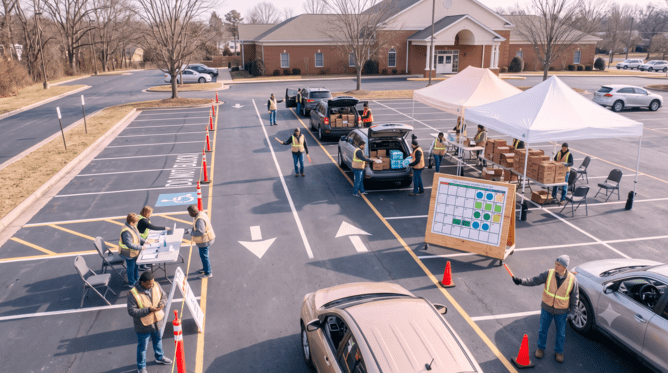
Traffic control deserves particular attention at drive-through events. Volunteers need visible positions, a clear vehicle route, emergency access, and instructions that keep pedestrians away from moving cars. Food-handling responsibilities may require added training based on the products distributed and the requirements of the supplying organization.
Church leaders should avoid collecting unnecessary personal information. Some partner programs require basic household or eligibility data; others do not. The church should know which fields are required, why they are collected, who can view them, and how records will be stored or destroyed. Volunteers should never photograph documents or discuss a household’s circumstances outside the approved process.
Dignity Depends On How The Distribution Is Operated

A free supply program can still create a difficult experience when instructions are unclear, volunteers make assumptions, or guests must explain private hardships repeatedly. Practical outreach should make access understandable without turning assistance into a test of worthiness.
Rock Church’s drive-through model may offer privacy and convenience for some households. It may be less accessible to people without vehicles. A congregation using the same approach should consider whether a walk-up option, delegated pickup procedure, public-transit connection, or referral to another distribution site is needed.
The San Diego Food Bank advises families that diaper distribution sites may have different hours and eligibility rules. Its online partner lists were updated on July 16, 2026, shortly before the Rock Church event. That emphasis on location-specific information is important: families should verify current details rather than assume every partner follows the same process.
Dignity extends to the supplies themselves. Churches should accept unopened diapers in usable packaging, check food dates and storage conditions, avoid distributing damaged products, and organize items so families receive what they can use. Diaper sizes are not interchangeable, and a large quantity of one size does not solve shortages in another.
The San Diego Food Bank reported that it supplied more than 9.1 million diapers to local families during the previous year. It also warned that full renewal funding for the program was uncertain. That funding pressure shows why churches should avoid promising an unlimited or permanent supply unless a partner has confirmed it.
Transparent limits are more respectful than an unreliable promise. Public notices can state the date, hours, format, supply limitation, contact person, and backup resource without overstating what the ministry can provide.
Churches Need Referral Plans For Problems A Distribution Cannot Solve
A food-and-diaper event may reveal other needs involving housing, utilities, health care, employment, transportation, childcare, domestic safety, or legal assistance. Volunteers should not try to solve every problem themselves.
Rock Church’s Provisions resource page directs visitors to organizations such as the San Diego Food Bank, Feeding San Diego, Stay Home SD, and 2-1-1 San Diego. This referral model gives volunteers somewhere responsible to point when a request falls outside the distribution’s purpose.
Churches in North Carolina can build a local version using county social services, regional food banks, diaper banks, school family-support teams, United Way 211 services, domestic-violence programs, housing organizations, and emergency-assistance providers. Each resource should be checked regularly. An outdated telephone number or discontinued program can create more frustration for a family already facing pressure.
Volunteers need simple boundaries. They can share verified information, contact a designated ministry leader, or help a guest reach an established provider. They should not provide legal, medical, financial, immigration, or mental-health advice unless they are acting through a qualified and authorized program.
Prayer or spiritual conversation should remain respectful and consistent with the church’s published approach. Food and essential supplies should never be conditioned on religious participation. Guests should know what the event offers before arriving and should not encounter unexpected pressure during a moment of material need.
What Churches Should Verify Before Expanding Practical Outreach
Rock Church El Cajon’s distribution offers a useful operating example, but churches should not copy it without considering their own location, partners, facilities, volunteer base, and community needs.
Leaders should confirm where supplies will come from, how often they can be provided, which storage rules apply, and what happens when demand exceeds inventory. They should review vehicle and pedestrian access, weather plans, volunteer screening, lifting expectations, insurance, privacy practices, accessibility, and referral procedures.
Churches should measure more than the number of bags distributed. Useful questions include whether the event started on time, whether instructions were accurate, whether guests could access the site safely, whether the correct diaper sizes were available, whether volunteers understood their roles, and whether partner organizations received the records they required.
No published source reviewed for this article reported how many households attended Rock Church’s July 21 event or how many units of food and diapers were distributed. Those results should remain unclaimed unless Rock Church or one of its partners releases them.
The strongest lesson is already visible in the event design. Practical church outreach connects a clearly defined need with qualified partners, scheduled volunteers, reliable public information, and realistic limits. Combining food with diapers recognizes that household hardship does not fit into one ministry category. Building the program around dignity and consistency helps the church serve as a trustworthy community partner rather than a temporary distribution point.