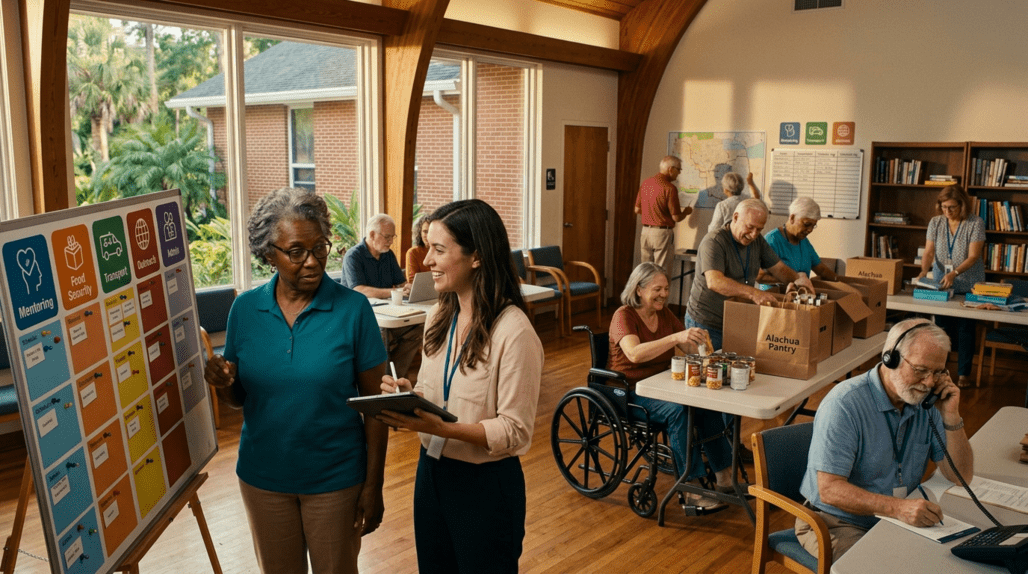
Alachua County’s new AmeriCorps Seniors grant offers more than another source of public funding. It presents a practical model for connecting adults aged 55 and older with structured service roles that match their experience, availability, and interests. Churches can learn from that model as they rethink how older members participate in food ministries, mentoring programs, congregational care, disaster response, transportation support, and neighborhood outreach.
Alachua County Community Support Services announced on July 20, 2026, that it had received an AmeriCorps Seniors Retired and Senior Volunteer Program grant. The federal award will establish an RSVP program serving Alachua County, Florida, and expand organized volunteer opportunities for adults aged 55 and older. The county’s official announcement said the initiative will complement its existing AmeriCorps Seniors Foster Grandparent Program. The national award database lists the Alachua County Board of County Commissioners for $85,500 in approved funding.
No announcement has identified local churches as formal RSVP partners yet. That distinction matters. The opportunity for congregations is prospective: churches can study the program, identify suitable service roles, and prepare to discuss partnerships with county administrators or other nonprofit organizations once implementation details become available.
What The Alachua County Grant Will Support
AmeriCorps Seniors RSVP was established in 1971 and remains one of the country’s largest volunteer networks for adults aged 55 and older. Volunteers can select assignments that fit their interests and schedules, ranging from a few hours to as many as 40 hours per week.
The program’s service areas extend far beyond traditional senior activities. RSVP volunteers may tutor children, support food-distribution programs, help residents prepare basic tax returns, assist communities after disasters, guide people through workforce resources, help older neighbors remain independent, and educate residents about fraud or public-health concerns.
Alachua County’s award was one of 130 RSVP grants totaling more than $19.8 million in the fiscal year 2026 RSVP grant awards, which included Alachua County, Big Brothers Big Sisters of Tampa Bay, the Community Services Council of Brevard County, Flagler Volunteer Services, and the Visiting Nurse Association of the Treasure Coast.
The range of recipients shows that RSVP is not limited to one type of organization. County governments, nonprofit agencies, educational institutions, faith-affiliated organizations, volunteer centers, and community-service groups can all help create or host suitable assignments.
For churches, the main lesson is that senior volunteering works best as an organized network rather than a series of occasional requests. A congregation may have experienced teachers, accountants, nurses, tradespeople, office managers, caregivers, drivers, and military veterans in its membership. A general appeal asking everyone to “help where needed” can overlook those skills. A structured system can connect each person with a role that has a clear purpose.
Why Churches Need More Defined Senior Volunteer Roles

Many congregations already depend heavily on older volunteers. They prepare meals, answer telephones, organize supplies, visit homebound members, maintain buildings, teach classes, lead committees, and support seasonal events. Their work can become so familiar that church leaders stop treating it as a volunteer-management system.
That creates several risks. The same dependable people may receive every request. Important tasks may rely on one person’s memory. New volunteers may not know where they fit. Members with mobility limits may assume there is no suitable role for them. Experienced professionals may be given repetitive tasks that do not use their knowledge.
RSVP’s approach offers a different starting point. AmeriCorps describes the program as a way for adults aged 55 and older to choose where, how, and how often they serve. That flexibility can help churches replace a one-size-fits-all volunteer model with assignments based on skills, time, physical ability, and personal interest.
A retired educator could mentor children or help volunteers prepare literacy activities. A former bookkeeper could support inventory controls for a food pantry without handling confidential donor information. A retired nurse might help create a nonclinical wellness-resource directory. A member with limited mobility could coordinate telephone check-ins, appointment reminders, or volunteer schedules from home.
These assignments should not be improvised around a person’s former job title. Each role still needs current training, clear limits, supervision, and an explanation of what the volunteer must not do. Professional experience is valuable, but retired volunteers should not be asked to provide medical, legal, financial, counseling, or safeguarding services outside an approved ministry process.
How A Church Partnership Could Be Structured
A congregation interested in working with an RSVP program should begin with a service assessment, not a recruitment campaign. Leaders need to identify genuine community needs, current nonprofit partners, available supervision, insurance questions, accessibility barriers, and the information volunteers may encounter.
The fiscal year 2026 RSVP competition prioritized work involving older adults and caregivers, strong families, homelessness, behavioral health, workforce reentry, and protection from fraud and scams. These priorities do not automatically become church programs. They point to areas where congregations may support qualified agencies through carefully defined volunteer assignments.
A church might serve as a meeting location, recruitment partner, supply-distribution site, or volunteer station. The county or lead RSVP agency would need to confirm which arrangements meet its grant requirements.
| Church Or Community Need | Possible Senior Volunteer Role | Needed Boundary |
|---|---|---|
| Food assistance | Inventory support, packing, appointment coordination | Food-safety training and protected household information |
| Children’s programs | Reading support or supervised mentoring | Screening, two-adult practices, and approved curriculum |
| Older-adult connection | Friendly calls, visits, or activity coordination | Consent, privacy rules, and referral procedures |
| Disaster support | Supply organization and communications | No unsafe field assignment without formal training |
| Fraud awareness | Distributing official educational resources | No personal financial advice or investigation |
| Transportation coordination | Scheduling rides through an approved program | Driver checks, insurance review, and mobility planning |
This planning stage protects volunteers and the people they serve. It can also prevent churches from accepting responsibilities they cannot supervise consistently.
Flexible Service Can Reach Volunteers Churches Often Miss

Traditional church volunteering can unintentionally favor people who are available during weekday mornings, can drive, can lift supplies, and are comfortable attending meetings. That leaves out many older adults who still want to contribute.
A stronger network offers several participation formats. Some volunteers may prefer one weekly assignment. Others may be available for short seasonal projects. Home-based roles can serve members with mobility or transportation barriers. Small teams can make assignments less physically demanding and reduce dependence on one person.
Flexibility should not mean unpredictability. Volunteers still need a named supervisor, written task description, schedule, orientation, and a reliable way to report concerns. Church leaders should know who is responsible when a volunteer is absent, when a recipient needs professional help, or when a task falls outside the role.
Accessibility deserves equal attention. Meeting spaces, restrooms, parking areas, work surfaces, printed materials, hearing support, and break schedules may affect whether an older volunteer can participate safely. A role can be meaningful without being physically strenuous.
The Centers for Disease Control and Prevention reports that supportive social connections are associated with better physical and emotional health, lower stress, reduced loneliness, and a stronger sense of belonging. The CDC identifies volunteering, faith-based activities, and involvement with community organizations as possible ways older adults can build connections.
Churches should not present volunteering as a treatment for isolation or a substitute for health care. They can recognize that well-managed service gives participants regular contact, purpose, and a visible place in community life.
Training Has To Match The Assignment

Senior volunteers bring experience, but experience does not remove the need for orientation. Every ministry setting has its own procedures, technology, reporting lines, and safety rules.
Training may cover privacy, emergency contacts, communication standards, lifting limits, food handling, child protection, digital security, transportation procedures, and how to refer requests that exceed the volunteer’s role. Volunteers working with children, vulnerable adults, money, confidential records, or home visits may require screening and added supervision.
AmeriCorps identifies the National Service Criminal History Check as a baseline requirement for covered national-service programs. Churches involved in a formal RSVP partnership would need to follow the requirements established by the grant administrator, the volunteer station agreement, church policy, insurers, and applicable law.
Training should remain proportionate. A volunteer making reminder calls does not need the same preparation as someone mentoring children or entering private homes. Overloading every participant with the same long orientation can discourage service. Undertraining people in sensitive assignments creates preventable risk.
Bethel’s previous discussion of volunteer training and emergency protocols reflects the same principle: goodwill must be supported by preparation, role clarity, and a response plan. Senior volunteer networks need that discipline from the start.
Churches Should Measure Reliability, Not Just Volunteer Hours
Volunteer programs often report the number of participants or total hours served. Those figures matter, but they do not show whether the program is dependable or useful.
A church should examine whether scheduled roles were filled, whether volunteers remained engaged, whether partner organizations received the support promised, and whether participants understood their assignments. Leaders can track training completion, cancellations, referrals, accessibility requests, incidents, and volunteer feedback without collecting more personal information than necessary.
Quality measures can remain simple. Did the food-distribution team complete its shift safely? Were mentoring sessions held with approved supervision? Did homebound members receive scheduled calls? Were concerns referred to the right staff member? Did volunteers feel that their time and experience were respected?
AmeriCorps expects RSVP grantees to use performance measures and collected data to evaluate their work and make program adjustments. Churches serving as partners may need to document approved activities in a consistent format. Recordkeeping should be discussed before the first assignment, including who owns the records and how private information will be protected.
Recognition should focus on service rather than competition. Public thanks, annual appreciation gatherings, written notes, ministry updates, and opportunities to mentor new volunteers can help people see that their work matters. Recognition should never disclose a recipient’s private circumstances or pressure volunteers to accept more responsibility.
What Churches Should Confirm Before Joining A Senior Volunteer Network
Alachua County’s $85,500 RSVP award does not mean local churches will automatically receive funds, volunteers, or program status. Congregations interested in the initiative should wait for official implementation details and speak directly with Alachua County Community Support Services before describing themselves as partners.
Church leaders should ask who will recruit and screen volunteers, who provides training, which assignments qualify, what insurance applies, how hours are recorded, what expenses can be reimbursed, and what reporting is required. They should confirm whether the church would act as a volunteer station, referral source, host site, or informal community partner.
The wider lesson extends beyond Florida. Churches in North Carolina and other states can review the RSVP grantees serving their own counties and learn how local networks operate. A congregation does not need to control every project to make a useful contribution. It may be more responsible to support an established food bank, school, senior center, disaster-response group, or caregiver organization.
Alachua County’s new program shows what becomes possible when senior service is treated as community infrastructure. Churches can build on that example by offering clear roles, flexible schedules, proper training, respectful supervision, and partnerships grounded in real local needs. That approach values older adults as skilled contributors rather than an emergency pool of unpaid help.