
Let’s be honest: weekly religious education can feel like shouting into a void. You might get 45 to 60 minutes of their attention. This is hard, with TikTok, soccer, and snacks pulling them away.
Retreats change everything. They offer a firehose of attention in one weekend. This is like getting a deep dive into a story where characters grow.
These experiences turn shallow talks into deep trust. We’re not just playing games or singing louder. We’re building a place where spiritual growth is sure to happen.
The goal is to break free from the weekly routine. We aim to create a space for real change. As shown in Christian retreats for children, these places help young people dive into faith. We want to spark deep connections that start a real spiritual growth journey.
Teaching formats
Choosing the right format for your kids church retreat is a big decision. It’s not about where you hold it, but how it feels. The place you pick shapes what you can do there.
Think of your options like political campaigns. One is grassroots, the other is presidential.

The Host Home model is like community organizing. You’re not renting a place; you’re using homes. Kids stay with volunteers, making small, cozy groups.
This approach is like a guerrilla campaign. It’s cheap, with costs mainly for food and crafts. The magic happens in the close, personal setting. A home feels different from a church basement.
But, you need to pick volunteers carefully. It’s like airport security. You’re looking for hosts who create a safe, fun, and spiritual space. Done right, you build a community.
The Off-Site Offensive: The Strategic Getaway
The D-Day option is to take buses to cabins or a camp. It’s a big effort with higher costs. But, it gives you something money can’t buy: separation.
You’re not just in a different room. You’re in a new world. No parents interrupting. You have their full attention. This makes bonding and spiritual focus stronger.
The downside is complexity. You deal with transportation, medical forms, and more. But, seeing kids talk about God by the lake is worth it.
Format Face-Off: A Quick Decision Matrix
| Consideration | Host Home Retreat | Off-Site Retreat |
|---|---|---|
| Primary Vibe | Intimate, neighborhood-based, community immersion | Immersive, getaway-focused, “camp experience” |
| Budget Profile | Low overhead, minimal venue costs | Higher fixed costs for lodging, food, and transport |
| Logistical Complexity | High-touch volunteer coordination, distributed management | Centralized but intense planning, risk management critical |
| Volunteer Need | Many screened hosts, strong small-group leaders | Fewer but highly trained staff, medical personnel advised |
| Unique Advantage | Deep connection to church family, authentic home environment | Complete removal from distractions, powerful shared memory creation |
Filling the Container: Thematic Teaching That Sticks
After choosing your format, you need great content. Your lessons must be as exciting as a Marvel trailer. They need to grab attention.
Consider “God’s Royal Inheritance.” It’s about kids being heirs, not subjects. It’s a powerful message in today’s world.
“Legacy” teaches kids to think about their impact. It shows how their choices matter. It’s a big idea for young minds.
“Limitless” challenges the boxes society puts kids in. It says God’s vision for them is beyond what society expects. It’s a message of freedom.
Your format sends a message before you even speak. Host Homes say “God is in your neighborhood.” Off-Site says “God is worth traveling for.” Your teaching just makes that message stronger.
Make your choice carefully. Then fill that space with truth that resonates. For more ideas on creating meaningful ministry moments, check out these 50 ways to strengthen ministry with. Your format is the vehicle. Make sure you’re taking them somewhere remarkable.
Worship and reflection
Free time can be the enemy of spiritual growth on retreats. It’s where good intentions often fade away. You’re not running a summer camp. Instead, you’re creating moments of worship, quiet, and connection.
Too much free time can lead to cliques and loneliness. This is where we move from just programming to true liturgy. Worship is not just a scheduled event. It’s the heartbeat of the entire experience.
The magic happens when we intentionally connect. Collective worship says, “We are part of something big.” Personal reflection asks, “What does this big thing want from me?” Structure helps create this dialogue.
Start with morning devotionals as the sun rises. It’s not about downloading information. It’s about setting the tone. Then, have small group discussions that feel like sacred circles of confession and wonder.
Evening sessions should be different. Around a fire, teaching becomes personal. This is where you wrestle with hard topics and introduce spiritual practices to take home.
Balance is key. Planned fun, like ropes courses, releases tension. But also, have unstructured time for connections to grow. This time should be supervised to prevent isolation.
The schedule below is more than a timetable. It’s a strategic map for different depths of reflection. Compare the formats:
| Reflection Format | Best Time of Day | Ideal Group Size | Depth Level | Leader Role |
|---|---|---|---|---|
| Morning Devotional | Sunrise / Early AM | Entire Group | Introductory / Centering | Facilitator & Guide |
| Small Group Discussion | Late Morning | 5-8 People | Personal / Vulnerable | Active Listener |
| Evening Teaching Session | After Dinner | Entire Group | Conceptual / Challenging | Storyteller & Teacher |
| Silent Individual Reflection | Afternoon | Solitary | Internal / Contemplative | Space Creator |
| Creative Expression Activity | Flexible | 2-4 People | Experiential / Non-Verbal | Resource Provider |
Notice the progression? You’re conducting a symphony, not just checking boxes. The morning centers. Small groups personalize. Evening sessions challenge. Silence internalizes. This rhythmic alternation prevents retreat fatigue.
The ultimate goal is transformation that lasts. These moments of worship and reflection create lasting memories. They fuel daily practice and mission work.
You’re not just filling time. You’re designing encounters. When worship and reflection work together, you create “productive discomfort.” It’s in this space that real change starts. The structure feels natural, but every moment serves a purpose.
That’s the alchemy. The schedule looks organic, but it’s carefully crafted. The result? A retreat that doesn’t just happen to people, but works on them. This is how you create an environment for genuine, sustainable growth.
Supervision and safety
Planning a kids church retreat means moving from pastor to project manager. It’s about using spreadsheets like they’re sacred texts. This part is all about making sure everything runs smoothly, like a well-oiled machine.
Imagine creating a peace treaty between chaos and order. One wrong move, like a food allergy issue or a bad volunteer, can ruin everything. Your job is to prevent all possible problems. This careful work is a true act of love.
Let’s talk about getting there. Will you use church cars, rent some, or have everyone carpool? Each choice needs strict rules for drivers. Make sure drivers have clean records, follow passenger limits, and stick to planned routes. The journey there sets the mood for the whole trip.
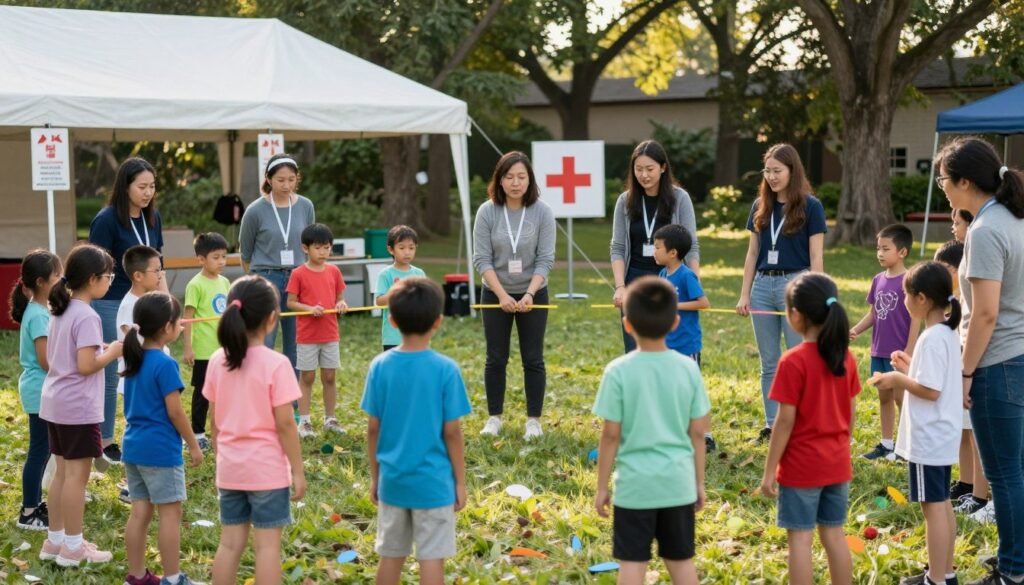
Next up is food and planning meals. It’s not just about saving money or using a venue’s kitchen. It’s about making sure everyone has something they can eat. Meal plans are like sacred texts, showing everyone that you care.
Volunteer management is also key. Background checks are a must. Make sure everyone knows their role and what to do in an emergency. A well-trained team is your best defense. For a detailed checklist, check out these common safety mistakes to avoid.
Then, there’s the digital world. Will you take phones away? It’s a bold move. It shows that real connections are more important than digital ones. Make sure everyone knows why this rule is important. Explain it as a chance to truly connect.
Lastly, plan the social scene carefully. Make sure everyone feels included. The space must be safe, both physically and emotionally. This requires careful planning and gentle guidance.
Every safety measure you take and every rule you share builds trust. It tells kids and parents that this place is special. Without a solid safety plan, your retreat could be just another field trip.
When done right, the safety plan is invisible. It supports laughter, sharing, and growth. The details might seem boring, but they’re essential. They turn a trip into a safe haven.
Reintegration into weekly ministry
The mountaintop experience ends when the bus returns to the church parking lot. That’s when the real test begins. Without a plan, your retreat becomes just another memory filed under “fun times.” The spiritual growth gets left in the woods.
Think of it like a movie’s third act. The work starts before the credits roll. You need to overcommunicate with parents. Send them a post-retreat briefing with specific questions. Move beyond “Did you have fun?” Ask about the prayer stations or what they learned about community. You’re giving parents a script to continue the conversation at home.
The bridge back to normal life is built intentionally. Maybe a student shares a testimony on Sunday morning. Perhaps you host a final debrief session in your regular youth room. This connects the sacred retreat space to the ordinary holy of weekly gatherings. It’s narrative re-entry.
The goal is simple: make the retreat a catalyst, not an island. Real, sustained spiritual growth happens in the daily grind, not just on getaway weekends. A solid program structure, like the one at Bethel UMC, understands this. It designs experiences that fuel ongoing engagement.
You’re not trying to maintain a spiritual high. You’re working to establish a new baseline. The transformation needs a forwarding address back in the real world. That’s how a weekend retreat becomes the foundation for a lifetime of faith.